Amreek Automation & Mechanical Systems
Free 1-Hour Project Consultation – No Commitment


Cloud Control vs Local Control For Mechanical Systems
- August 9, 2026
- Technical Insights
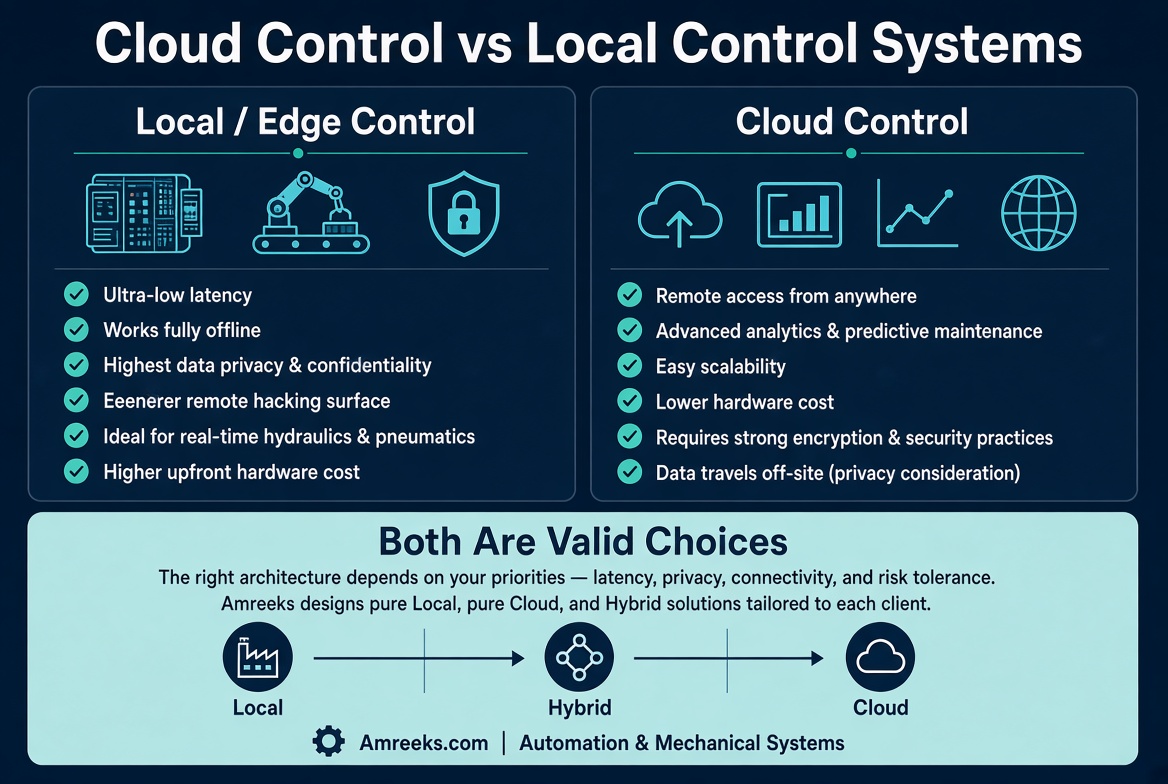
Cloud Control vs Local Control Systems | Amreeks Automation
In modern automation, the choice between cloud control and local (edge) control systems directly impacts reliability, response time, cost, and security. Whether you run a small manufacturing plant, manage hydraulic or pneumatic equipment, or build residential smart systems, understanding the difference helps you make the right investment.
This guide breaks down both approaches in plain language so you can decide what fits your operation.
What Is Local (Edge) Control?
Local control systems process data and make decisions on-site using PLCs, industrial PCs, or dedicated controllers next to the equipment. Core operations continue even if the internet is unavailable.
Best suited for:
- High-speed hydraulic and pneumatic actuators
- Safety-critical machines
- Sites with unreliable connectivity
- Applications requiring the highest data privacy
What Is Cloud Control?
Cloud control systems send selected data to remote servers for analytics, monitoring, and decision support. Teams can access dashboards and diagnostics from anywhere.
Best suited for:
- Multi-site visibility
- Predictive maintenance and advanced analytics
- Remote support and software updates
- Scalable IoT deployments
Side-by-Side Comparison
| Factor | Local / Edge Control | Cloud Control |
|---|---|---|
| Latency | Extremely low (milliseconds) | Higher (depends on connection quality) |
| Reliability | Works fully offline | Requires stable internet for full functionality |
| Privacy & Data Confidentiality | Data stays on-site by default | Data is transmitted and often stored remotely |
| Hacking & Cyber Risk | Smaller attack surface; limited remote exposure | Larger potential surface; requires strong security |
| Scalability | Limited by local hardware | Highly scalable |
| Upfront Cost | Higher hardware investment | Lower hardware, ongoing service costs |
| Maintenance | Local technicians | Remote updates and diagnostics possible |
| Best Use Case | Real-time machine & safety control | Monitoring, analytics, multi-site management |
Privacy, Confidentiality & Security Considerations
Local Control Because process data remains on-site, privacy and confidentiality are inherently stronger. Sensitive production parameters, recipes, or operational data never leave the facility. The attack surface for remote hacking is smaller, which many small manufacturers and residential clients prefer for critical systems.
Cloud Control Data travels over networks and is processed or stored externally. This introduces additional considerations around encryption, access control, compliance, and potential exposure. Modern cloud platforms can be highly secure when properly configured (TLS encryption, zero-trust principles, role-based access, regular audits). However, the risk profile is different and must be actively managed.
Neither approach is risk-free. Local systems can still be compromised through physical access or poorly secured local networks. Cloud systems can be very secure when designed with strong architecture and ongoing monitoring. The key is matching the security model to the client’s risk tolerance, regulatory requirements, and operational reality.
How Amreeks Approaches This Decision
At Amreeks we do not push one architecture over another. We start with your process requirements, risk profile, connectivity situation, and budget. Then we design and build the solution that fits:
- Pure local PLC and edge-based control systems for hydraulics, pneumatics, and high-speed machinery
- Secure cloud-connected IoT and monitoring platforms
- Hybrid architectures that keep critical control local while enabling remote visibility and predictive insights
- Full integration with mechanical design, CAD/CAM, FEA validation, fabrication, and prototyping
Our goal is simple: give you a reliable, secure, and practical system that matches how you actually operate.
Ready to Choose the Right Architecture?
If you are evaluating control systems for a new machine, retrofit, or residential automation project, we can help you map the optimal balance of local and cloud capabilities — including privacy and cybersecurity considerations.
Contact Amreeks for a free consultation. Tell us about your application and priorities, and we will recommend a tailored solution that works for you.
Post Tags: